Why plan spare parts at the quotation stage?
When purchasing electric hospital beds, the support arrangements throughout their use deserve consideration alongside product functions and unit price. Waiting until a fault occurs to establish which part is needed, where to obtain it and who will replace it leaves questions unresolved that could have been addressed during procurement.
Before asking “How many spare parts should we buy?”, ask “How will we identify the components in the beds supplied and manage service requests?” For hospitals, this brings biomedical engineering requirements into the purchasing process. For distributors, it clarifies the support arrangements behind the products they represent.
1. Record the supplied configuration, not just the model name
Create one record containing the quoted model code, approved equipment and included accessories. Link that record to serial numbers at delivery. For subsequent orders, do not assume that an unchanged model name means every component remains identical.
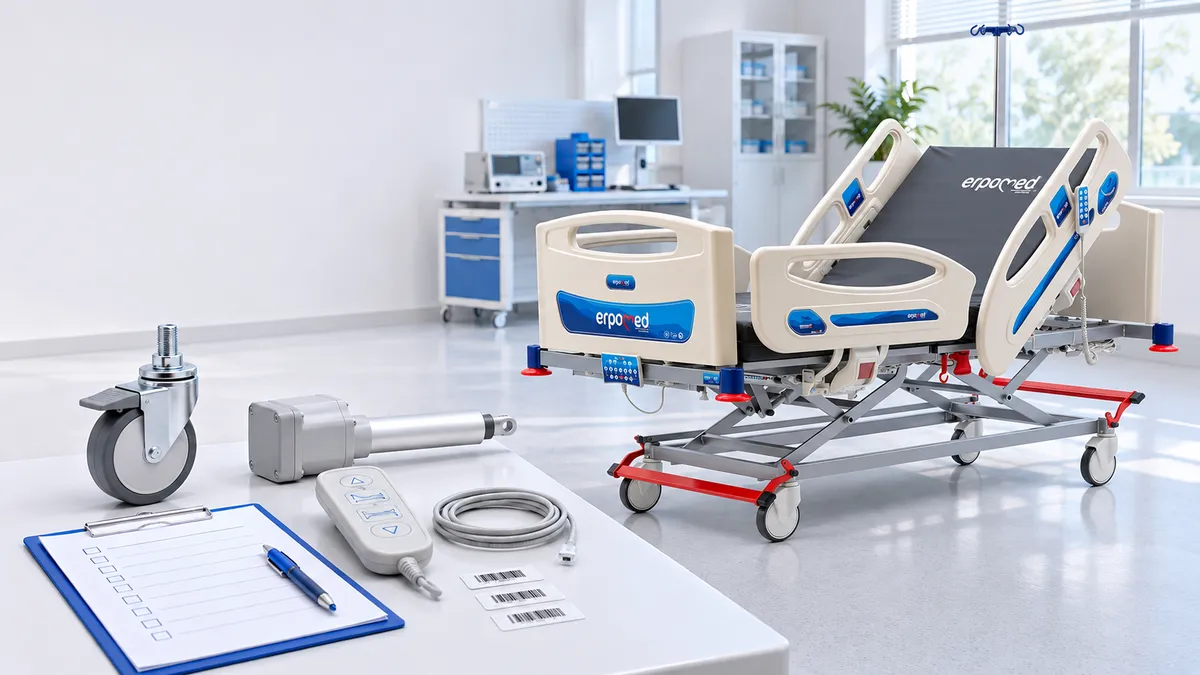
For example, ERPOMED’s ERCARE-500 product page lists column motors, electronic and manual CPR mechanisms, and centrally lockable castors. Service planning for these features should use parts documentation corresponding to the configuration being supplied. Erpomed
2. Request identifiable parts records
Generic descriptions such as “bed motor” or “handset” may be insufficient for ordering. Ask the manufacturer for part codes and compatibility information for components identified as replaceable within the service arrangements.
A useful parts list can include:
Part name and ordering code.
Compatible model, configuration or serial-number range.
Whether the item is supplied individually or as an assembly.
Required servicing competence and relevant service documentation.
Price and lead time to be confirmed when ordering.
Do not treat visual similarity as confirmation of compatibility. Link component selection and replacement work to the manufacturer’s instructions.
3. Avoid an arbitrary percentage for initial stock
There is no single spare-parts ratio suitable for every bed project. Assess the manufacturer’s recommendations together with the number of beds, installation locations, local servicing capability and confirmed replenishment lead times.
Part price should not be the only consideration. A component whose local unavailability could affect a bed’s use may warrant a different priority from an item that can be ordered for planned maintenance. Establish these priorities with biomedical engineering and the manufacturer; do not infer failure rates from a product page.
4. Separate parts supply from service coverage
Including a spare part in a quotation does not automatically include labour, an on-site visit or transport. Clarify warranty coverage, exclusions, the support request channel and the process for returning replaced components in writing.
Distributors should also ensure that commitments made to customers match the arrangements agreed with the manufacturer. Unconfirmed response or delivery times should not become customer guarantees.
5. Complete the purchase with a tracking record
For each bed, record its model, serial number, installation location and associated documents. Parts requests can then link the reported issue, requested code, compatibility confirmation and service outcome within the same record.
Explore the ERPOMED ERCARE-500 electric intensive care bed. Share your bed quantities, intended locations and local service arrangements, and request a configuration-specific explanation of spare-parts supply and support alongside your quotation.