Start with the equipment, not the trolley
A photograph of a medical device trolley cannot establish whether it is suitable for the equipment you intend to use. Beyond fitting on the platform, the device needs accessible connections, an appropriate working height and space for its accessories within the intended room layout.
Hospital procurement teams should bring clinical users and biomedical engineering staff into the same requirements review. Distributors should establish the end user’s device make and model before preparing a quotation. A general request for a “medical device trolley” may not produce comparable offers.
1. Compare usable platform space, not just overall dimensions
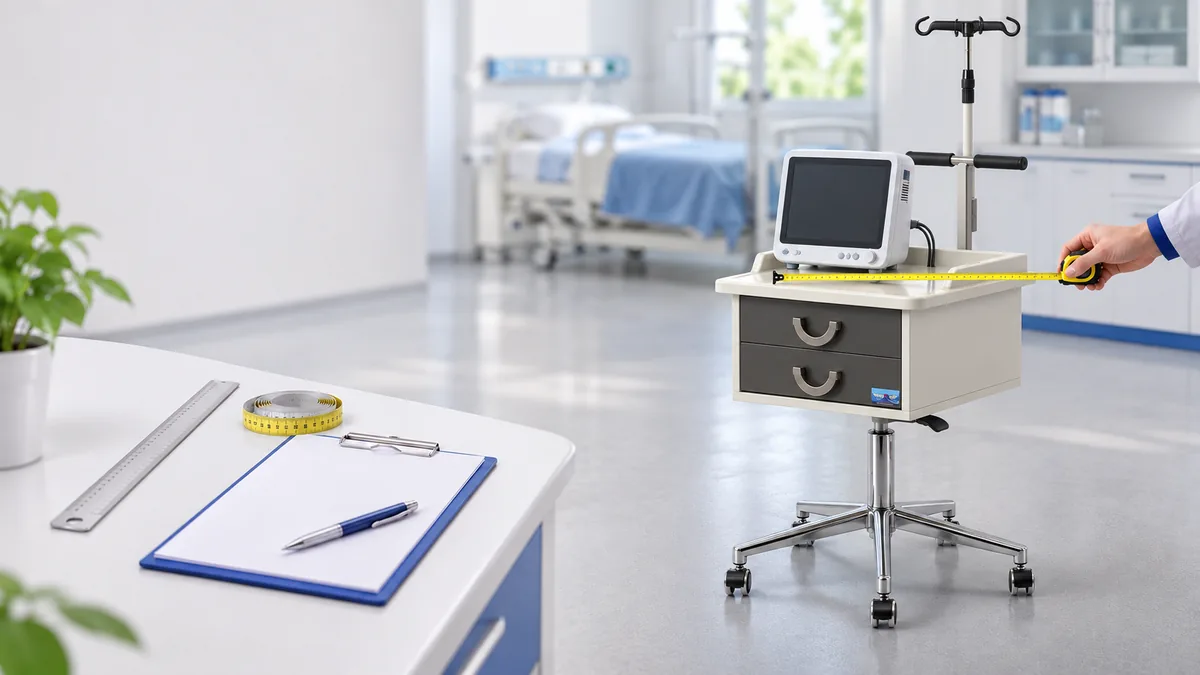
Obtain the device’s width, depth and weight from its manufacturer’s documentation. Consider the power adaptor, connected accessories and any components that extend beyond the device during use.
Ask the trolley supplier for the usable platform dimensions as well as the trolley’s overall dimensions. Could raised edges interfere with the device’s feet, ventilation openings or connections? Will the screen and controls remain accessible?
Protective edges alone do not establish that the device’s securing requirements have been met. Check the equipment manufacturer’s positioning and mounting requirements separately.
2. Confirm load limits and load distribution in writing
Assess the device, accessories and intended drawer contents together. Request the overall load limit and any separate limits for the platform and drawers.
If a value is not published, do not substitute the capacity of a similar model. Provide the supplier with the device’s footprint and planned position alongside its weight. Compatibility with a particular device should be confirmed using this information.
3. Assess working height in the intended setting
The height needed to read a screen, operate controls and access connections depends on the working environment. When considering a height-adjustable trolley, compare its adjustment range with the tasks staff perform while seated or standing.
ERPOMED’s ERP-6280 product page lists hydraulic height adjustment, an ABS top platform and two drawers. These features provide a starting point for evaluation; they do not, by themselves, establish compatibility with a particular device. Erpomed
4. Review cables, travel routes and parking space
Check where power and data cables will run and whether connections remain accessible when drawers are opened. If cable management or electrical accessories are required, ask explicitly whether they are included in the quotation.
Review doorways, turning space and the planned bedside parking position. Swivel castors do not automatically mean that brakes or directional locks are provided; confirm the functions your application requires.
5. Complete the quotation with a compatibility record
Include the following in your request for quotation:
Device make, model, dimensions and weight.
Accessories used with the device.
Required working height and parking space.
Mounting, cable management and braking requirements.
Quantity and scope of delivery.
For larger purchases, request a sample assessment or demonstration before placing the order. Distributors should keep customer-facing compatibility commitments within the configuration confirmed with the manufacturer.
Explore the ERPOMED ERP-6280 Medical Device Trolley. Share your equipment details and layout requirements to request an assessment of the configuration suitable for your project.ojenize uygun konfigürasyonun değerlendirilmesini isteyin.