How to Plan an On-Site Stretcher Demonstration Before Buying
Buying a hospital stretcher involves more than comparing a specification sheet with a price quotation. A patient transport stretcher also needs to fit the hospital’s routes, working practices and equipment arrangements. Doorways, corridor turns, lift entrances and transfer locations can reveal practical considerations that are difficult to assess from a catalogue.
A structured stretcher demonstration gives procurement teams, clinical users and technical staff an opportunity to evaluate the same equipment under agreed conditions. It also helps distinguish essential requirements from features that are useful but not necessary for the intended application.
For hospitals and medical equipment distributors, the objective is to establish whether the proposed configuration suits the site. The following steps provide a practical framework for an on-site hospital stretcher evaluation.
1. Define how the hospital stretcher will be used
Before arranging the demonstration, document the intended department, typical transfer routes and expected users. An emergency stretcher used in a busy emergency department may be assessed differently from equipment intended mainly for scheduled transfers between wards.
Begin with practical questions. Which departments will the stretcher connect? Are there narrow doorways or frequent changes of direction? Which accessories will travel with it? Where will it be parked and cleaned? Will different teams use it across several shifts?
These answers should determine the demonstration programme. Without an agreed use case, participants may assess the same product against different expectations.
Also distinguish between current requirements and possible future applications. A function that might be useful later should not obscure a limitation affecting everyday operation.
2. Include the people who will use and support it
A hospital stretcher demonstration should involve more than the purchasing department. Staff who move, position, clean and maintain the equipment can identify different practical issues.
Patient transport staff can assess handling and push-handle access. Nursing representatives can examine side rails and controls. Biomedical engineering personnel can review maintenance information and service arrangements. Cleaning staff can assess whether the cleaning instructions can be applied within the hospital’s existing workflow.
Appoint one coordinator to manage the route, participant list, questions and assessment form. This person should also record unresolved issues.
For distributors, the demonstration is an opportunity to explain the equipment clearly and collect site-specific requirements. Questions that cannot be answered during the visit should receive a documented follow-up.
3. Prepare a representative patient transfer route
A wide, empty corridor is convenient for a product presentation, but it may not represent daily patient transport. The demonstration route should include the conditions that matter at the site.
Consider a room entrance, a corridor turn, a lift doorway and the designated parking area. Check available clearances beforehand. Where thresholds, powered doors or temporary obstructions are relevant, agree how they will be assessed with the appropriate hospital team.
Start without a patient. If a loaded assessment is required, use approved test loads and follow the manufacturer’s instructions and the hospital’s procedures. Do not use a staff member lying on the stretcher as a routine substitute for an agreed test method.
Plan the visit to avoid disrupting patient care or blocking operational routes.
4. Confirm that the demonstration matches the quotation
One of the most important stretcher purchasing questions is whether the demonstrated unit matches the equipment being offered.
Record the model, mattress, castor arrangement, side rails, handles and accessories. Identify which items are standard and which are optional. Do not assume that every accessory fitted to the demonstration unit is included in the quoted price.
Accessories can also affect clearance and storage arrangements. Assess the intended configuration rather than an incomplete unit that occupies less space.
If the quotation changes after the demonstration, check whether those changes affect the assessment. The final purchasing record should identify the configuration that was actually reviewed and any differences requiring further confirmation.
5. Assess manoeuvrability, braking and steering
Evaluating a patient transport stretcher requires more than pushing it along a straight corridor. Observe starting, stopping, turning, positioning in restricted areas and parking.
When reviewing a central-brake stretcher, check pedal accessibility and how users identify the selected brake state. If a steering function is provided, assess its operation and release according to the manufacturer’s instructions.
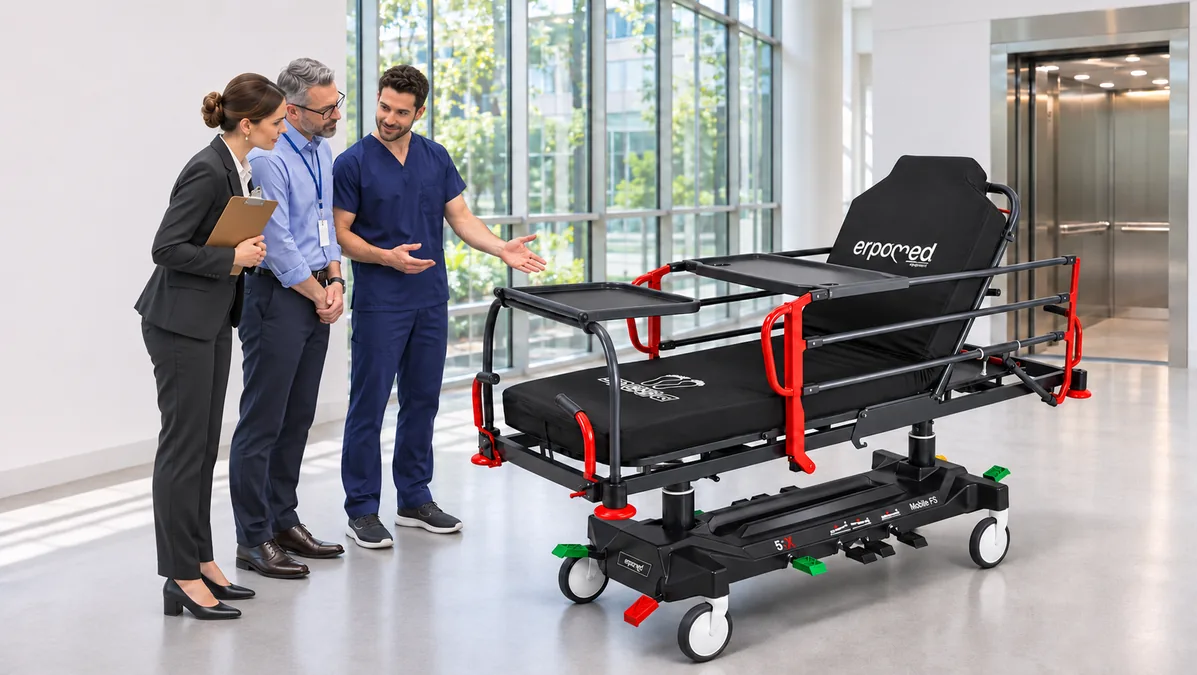
The ERPOMED MOBILO FS functional emergency stretcher, for example, is listed with central-brake castors, a fifth steering castor and foldable push handles. These features can be reviewed on the hospital’s agreed demonstration route.
Replace vague comments such as “easy to use” with specific observations. Note where additional manoeuvres, clarification or changes in hand position were needed.
6. Review controls and transfer interfaces
When assessing a hydraulic stretcher or adjustable patient transfer stretcher, examine control location, accessibility and ease of understanding.
After the supplier’s introduction, ask intended users to demonstrate the relevant operating steps. These may include adjusting height, opening and closing side rails and using the push handles. Observe whether moving components have adequate clearance in the intended location.
Also review how the stretcher will be positioned beside beds, examination areas or other transfer surfaces. Use agreed scenarios without patients during the initial assessment.
A feature appearing in a catalogue does not establish compatibility with every transfer location. Compatibility needs to be checked against the actual configuration, available space and hospital procedures.
7. Include cleaning, maintenance and service questions
Hospital stretcher prices should be considered alongside the work required to support the equipment. Inspect access to mattress surfaces, rail connections, accessory sockets and the lower frame.
Do not infer cleaning-agent compatibility from the appearance of a material. Check the manufacturer’s written cleaning instructions, including permitted products, application methods and restrictions.
Biomedical engineering staff should ask about routine checks, documentation and spare-parts identification. Confirm which model or serial details are required when requesting parts and how technical support enquiries are submitted.
Warranty terms, service scope and spare-parts arrangements should be documented in the commercial offer. A verbal explanation during the demonstration should not be the only record of an important purchasing condition.
8. Use the same assessment form for each model
When comparing hospital stretchers, use the same route and practical scenarios wherever appropriate. An assessment form can cover handling, brake access, controls, accessory placement, cleaning access and documentation.
For each item, record “acceptable”, “clarification required” or “not acceptable”, followed by a short observation. Separate mandatory requirements from preferences. A critical mismatch should remain visible rather than disappear within an overall score.
At the end of the demonstration, list outstanding questions, responsible contacts and expected response dates. Make the purchasing decision against the proposed configuration and the completed clarification record.
This approach gives hospitals and distributors a shared reference when discussing the final quotation.
Frequently asked questions
How long should a stretcher demonstration take?
Allow enough time for the product introduction, practical assessment and review discussion. The required duration depends on the route, number of participants and functions being examined.
Can every stretcher be tested in the same way?
Comparison scenarios can be consistent, but each model must be assessed within its own instructions and operating limits.
What should be recorded afterwards?
Document the model and configuration, participants, observations, unresolved questions and any purchasing conditions requiring confirmation.
To discuss a suitable hospital stretcher configuration, share your department requirements, transfer route and accessory needs with ERPOMED. These details help turn a general product presentation into a focused procurement assessment.